
St. Cloud is Creating an Automation Economy
26 Jan 2026
News
Automation is a top priority for companies across the United States, with 65% of CFOs stating that their strategic priority over the next 12 months is automating tasks. Automation is an umbrella term that encompasses various action items, including introducing new software tools, updating machinery, and utilizing artificial intelligence (AI). Each company has unique automation goals and different budgets and timelines to reach them.
“Innovation is at the heart of automation; it is the drive to do things better,” says Cathy Mehelich, Economic Development Director for the City of St. Cloud Economic Development Authority (EDA). “St. Cloud is uniquely positioned to lead automation efforts in the future because of its highly educated workforce that has roots in manufacturing.”
Almost a third of St. Cloud residents 25+ have a bachelor’s degree. At the state level, 8.5% of Minnesota jobs are in science and technology, while Minnesota ranks seventh in technology innovation. Read more about the automation industry and how St. Cloud is preparing to embrace it.
St. Cloud’s Printing Industry Reflects a History of Automation
You don’t have to look far to see evidence of automation in the St. Cloud economy. Throughout the 20th century, St. Cloud was a leading city in the printing and publishing industries. According to King Banaian, professor of economics at St. Cloud State University (SCSU), local newspapers were printed in both English and German from the 1870s until the start of World War II.
“Printers were producing twice as many newspapers in St. Cloud compared to other parts of the country,” says Banaian. “To make the printing process faster and easier, they automated.”
Newspaper and magazine printers invested in more advanced presses and eventually transitioned to computer-based systems. The typesetters from 100 years ago learned the new systems and evolved with the industry.
Today, printing still has a presence in St. Cloud. “This remains a huge industry in the region; it has just pivoted with technology,” says Luke Greiner, a Regional Analyst for the Minnesota Department of Employment and Economic Development (DEED). “There are currently around 500 printing jobs in St. Cloud with an average salary of $75,000 annually.”
Automation will impact every industry in some way as companies continue to challenge traditional ways of doing things. Cities that lead in innovation will be well-positioned to welcome businesses eager to do things better, faster, and more safely.
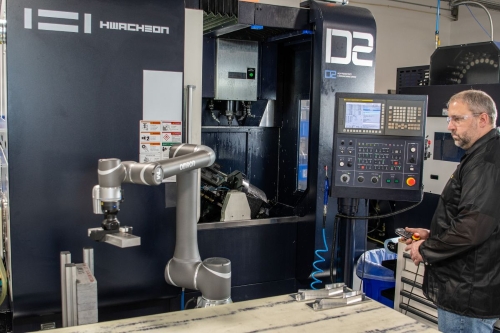
St. Cloud is Home to Companies That Assist With Automation
There are already companies operating in St. Cloud that specialize in automating processes. Central McGowan builds machines that make processes less labor-intensive, while offering consulting services to help companies embrace automation opportunities. Advanced Interconnect Technologies believes in excellence through automation, developing precision manufacturing systems for a wide range of industries.
“Many companies say that they want to automate, but aren’t sure where to start, how much it costs, or how to determine if the updates were successful,” says Mehelich. “The automation firms in St. Cloud offer guidance and recommendations, creating a clear path to improved operational systems.”
It makes sense that automation firms would choose St. Cloud because it already has a strong manufacturing foundation. Nearly 15% of the workforce is employed in manufacturing across 333 regional businesses. This manufacturing knowledge, combined with the region's high education rates, creates a community of innovators who are familiar with technological processes and want to make them better.
Automation Allows Companies to Scale With Existing Assets
Many people have concerns about automation and AI, particularly regarding how new systems will impact job security. While AI could displace up to 7% of the American workforce, experts believe that technology will also create new jobs, opening opportunities for people to transition into new careers.
For example, the team at Goldman Sachs says,”60% of US workers today are in occupations that didn’t exist in 1940.” The report goes on to say that, “predictions that technology will reduce the need for human labor have a long history but a poor track record.”
St. Cloud’s historic printing industry is a perfect example of this. As newspaper and magazine printers innovated beyond typesetting, new job opportunities emerged for journalists, graphic designers, advertising teams, and other industry professionals.
The future of automation isn’t about replacing workers; it’s about changing what they do. This will allow companies to do more with the resources they currently have.
“Robotics is successful where it is complementary to the worker,” says Greiner. “The humans and machines work alongside each other. This also helps workers upskill and increase their incomes because they are handling more complex tools.”
In the world of economic development, automation allows communities to attract and retain businesses, even without a rapidly growing population.
“American cities can’t grow their labor force as well as they used to,” says Greiner. “Automation allows us to increase our output without needing more bodies.”
This is also essential in physically demanding or undesirable roles. Automation can save lives and protect human bodies by making tasks less labor-intensive.
Step Into the Future in St. Cloud
The companies of St. Cloud have always innovated as new tools, opportunities, and industries reached this community. Today, St. Cloud is an automation leader, with firms helping organizations worldwide improve their processes and modernize production.
Choose a city with a strong education background, manufacturing experience, and a culture of innovation. Contact us to discuss your organization’s needs and how we can help you thrive in St. Cloud’s automation economy.
More Topics