
The Information Technology Industry is Booming in St. Cloud
2 Feb 2026
News
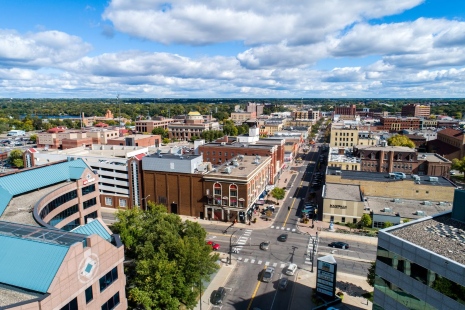
St. Cloud, Minnesota, might not have as flashy a reputation as San Francisco, Seattle, and Austin, but that doesn’t mean it isn’t a technology hub. The region is home to over 5,000 information technology (IT) professionals who support a diverse range of industries and work with global companies.
“The state of Minnesota invested heavily in STEM education over the past decade,” says Cathy Mehelich, Economic Development Director for the City of St. Cloud Economic Development Authority (EDA). “The St. Cloud school districts often took these guidelines even further, creating a generation of curious problem solvers. It makes sense that many would enter the IT field.”
In 2025, global IT spending was projected to grow by 9.3%, defying economic uncertainty. IT investment will continue in the coming decade as companies continue to automate and innovate.
The St. Cloud IT industry is prepared to grow with it. Learn more about the field of information technology and how St. Cloud has quietly become a leader in Minnesota, if not the nation.
A Diverse Economy Creates IT-Adjacent Industries
Information technology is found in almost every company across the country. IT professionals maintain eCommerce sites while optimizing internal systems. Every business, from a lumber company with an Internet-connected warehouse to a doctor’s office digitizing medical records, needs IT.
It makes sense that St. Cloud has become an IT hub, as it has always had a diverse range of industries. Even when the region was renowned for its granite production, it also maintained strong food processing, shipping, and printing economies. As technology evolved, representatives from each of these industries explored ways to innovate and adopt modern solutions.
“Even when an industry was in decline, it didn’t kill the city,” says Luke Greiner, a Regional Analyst for the Minnesota Department of Employment and Economic Development (DEED). “Residents pivoted and evolved to embrace new opportunities.”
These diverse industries are creating technology hubs. King Banaian, a professor of economics at St. Cloud State University (SCSU), uses the example of banking technology to demonstrate how new industries are forming through IT innovation. A banking software company isn’t part of the finance world, it comes from IT and Fintech. A company like Zillow isn’t in the real estate industry. Instead, it is a technology company that leads the RealTech field.

There Are Several Location Advantages to Choosing St. Cloud
Companies within the IT field often have different location advantage criteria compared to other industries that ship physical goods across the country. However, St. Cloud can meet the needs of digital-first organizations just as well as a manufacturing facility or food distribution company. A few reasons to choose St. Cloud include:
- Excellent internet connectivity: St. Cloud is one of the “most wired” cities in Minnesota, with a tremendous internet backbone capacity with long-haul fiber and diverse paths to the Twin Cities 511 building. St. Cloud also has competitive, affordable, high-speed broadband Gb services from multiple providers.
- Significant investments in higher education: St. Cloud is one of the top cities in the country for college graduates. It both attracts residents with degrees and helps locals graduate through multiple educational institutions within the city. St. Cloud State University offers the only graduate program in Information Assurance in the Minnesota State System.
- Centrally located: Minnesota is based in the Central Time Zone, making it easy to communicate with both the East and West Coasts throughout the day.
- Actively growing: Metropolitan St. Cloud is expected to grow by 25% between 2010 and 2030.
These advantages are why brands like GeoComm, Wolters Kluwer, and Preferred Credit Inc. choose St. Cloud.
St. Cloud Offers an Affordable Cost of Living
The affordable cost of living is another reason why information technology companies should consider St. Cloud for their expansion or relocation plans. Central Minnesota is more affordable than the Twin Cities and considerably cheaper than many of the “tech hubs” across the United States.
“Labor costs are lower in St. Cloud compared to other parts of the country,” says Greiner. “While employees might receive lower salaries, they often make up the difference with the low cost of living. They especially make up for it in childcare and housing costs.”
For example, someone who earned $100,000 per year in Seattle would only need to earn $67,400 per year in St. Cloud to enjoy the same standard of living (according to Payscale). The median home price in St. Cloud in 2025 is $424,510 compared to $1.09 million in Seattle. Other cities have similar affordability metrics compared to Central Minnesota.
Learn More About Information Technology in St. Cloud
The IT field has been growing in St. Cloud for more than a decade, and will continue to be an important part of its economy. Learn more about IT within Metropolitan St. Cloud and see why it is growing. Your company, regardless of its technology specialty, has a promising future here.
Contact the St. Cloud EDA to discuss your business expansion plans, including changes to the downtown region. See how your business can thrive here.
More Topics

St. Cloud is Creating an Automation Economy
Jan 26 2026